Capital Catering
Transforming a legacy catering operation into a premium digital experience

Transforming a legacy catering operation into a premium digital experience
Capital Catering is one of the UAE’s most established premium catering companies, operating under the ADNEC Group. With a portfolio spanning exhibitions, aviation, healthcare, education, corporate events, and weddings, the company serves clients ranging from private families and VVIPs to government entities and international exhibition organizers.
For years, Capital Catering managed its entire operation manually. Clients would phone in orders, negotiate custom selections across more than 20 different menus, and coordinate logistics through Excel spreadsheets and back-and-forth emails. There was no unified digital presence, no online ordering capability, and no centralized system for tracking orders from inquiry to fulfillment.
Capital Catering came to Digital of Things (DOT) with a clear ambition: move the business online. That ambition, however, came in two parts. First, they needed a Capital Catering (CC) informational website to establish brand presence and communicate their positioning as a premium catering provider. Second, and far more complex, they needed Capital Catering+ (CC+), a fully functional e-commerce platform where customers could browse menus, customize orders, and check out directly.
The scale of Capital Catering’s ambition quickly revealed a deeper issue. The business was not yet aligned on its own requirements.
Multiple departments had a stake in the project: IT, marketing, kitchen operations, finance, and business leadership. Each department operated with its own processes, its own priorities, and its own vision of what “going online” should look like. Getting these stakeholders into alignment became the project’s first and most persistent challenge.
Beyond stakeholder alignment, the operational complexity was significant. Capital Catering offered more than 20 menus, from gold-tier wedding packages to VIP exhibition catering to itemized takeaway selections. Each menu had different rules: minimum order thresholds, lead time requirements for certain dishes, restrictions on mixing items across menu types, and multiple payment methods including bank transfers. Translating all of this into a coherent digital experience required a deep understanding of both the business logic and the customer journey.
Adding to the complexity, the client had committed to WordPress as the development platform. While a reasonable choice for a content-driven site, WordPress introduced significant limitations for the level of e-commerce customization that CC+ demanded. The team would need to design within these constraints without compromising the user experience.
The timeline compounded these pressures. Capital Catering team had set an aggressive launch target, giving the team only a few months to deliver two complete platforms, bilingual in English and Arabic, with full responsive design.
Discovery and stakeholder alignment
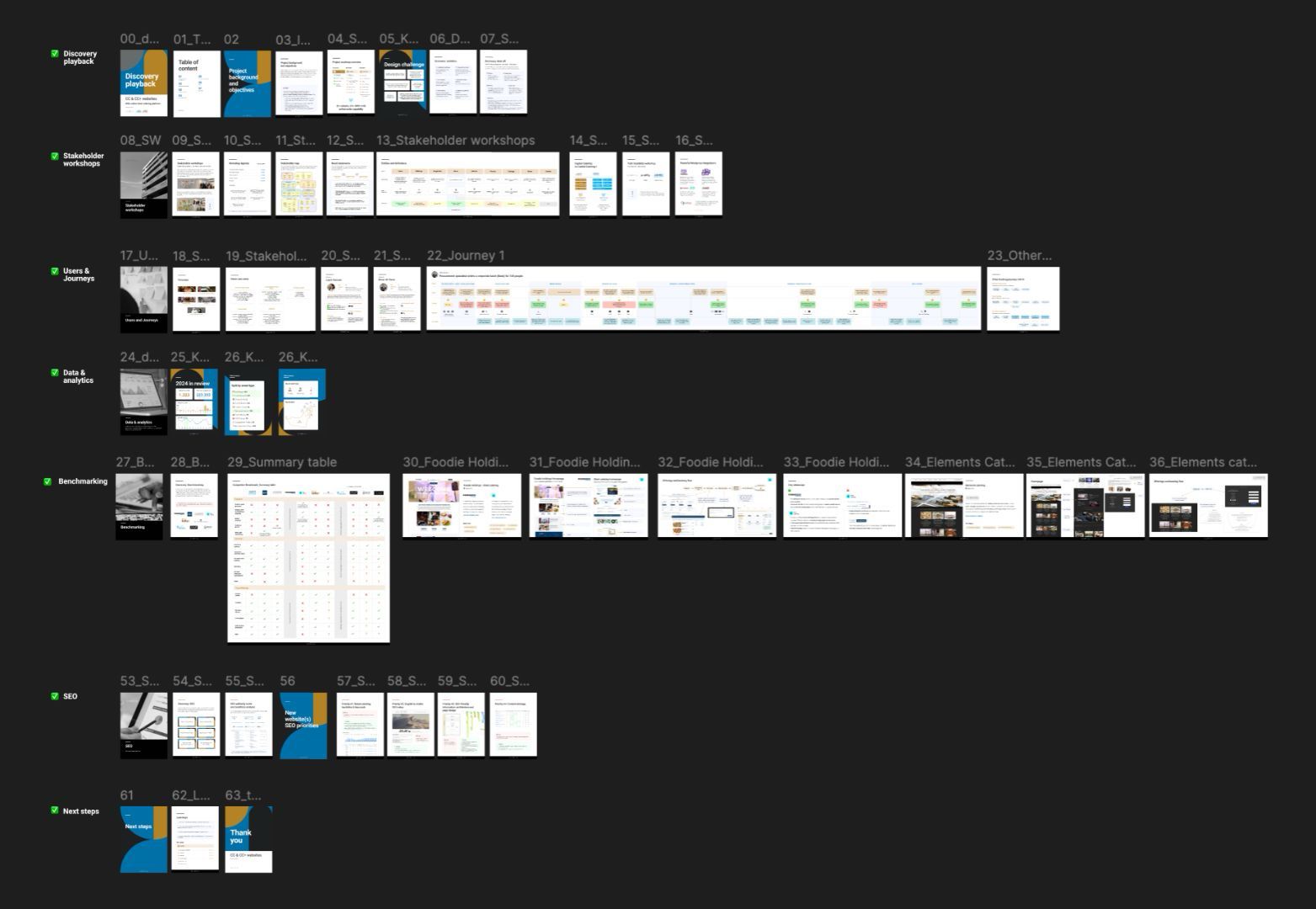
Digital of Things (DOT) team began with an intensive discovery phase, running three stakeholder workshops to bring all departments together and establish a shared understanding of the project’s objectives. These sessions involved key representatives from IT, marketing, kitchen operations, finance, and the C-suite. The workshops served a dual purpose: extracting business requirements and surfacing the internal misalignments that would need to be resolved before any design work could begin.
The team identified five primary user personas, including private families, wedding planners, corporate buyers, VVIP clients, and exhibition organizers. For each persona, DOT mapped the existing journey from inquiry to booking, documenting pain points and opportunities for improvement.
Competitive and SEO analysis
DOT conducted a comprehensive benchmarking exercise across six regional competitors, focusing specifically on catering businesses rather than delivery platforms. The analysis identified critical success factors: pricing transparency, visual menu organization, and streamlined ordering workflows. The team compiled findings with clear recommendations on what to adopt, what to avoid, and where Capital Catering could differentiate.
In parallel, a targeted SEO audit assessed Capital Catering’s existing domain authority and backlink profile. Recommendations covered multilingual indexing strategy, English-to-Arabic setup, and content optimization for transactional and commercial keywords. This work was delivered in collaboration with a specialist SEO contractor.
Menu simplification and information architecture
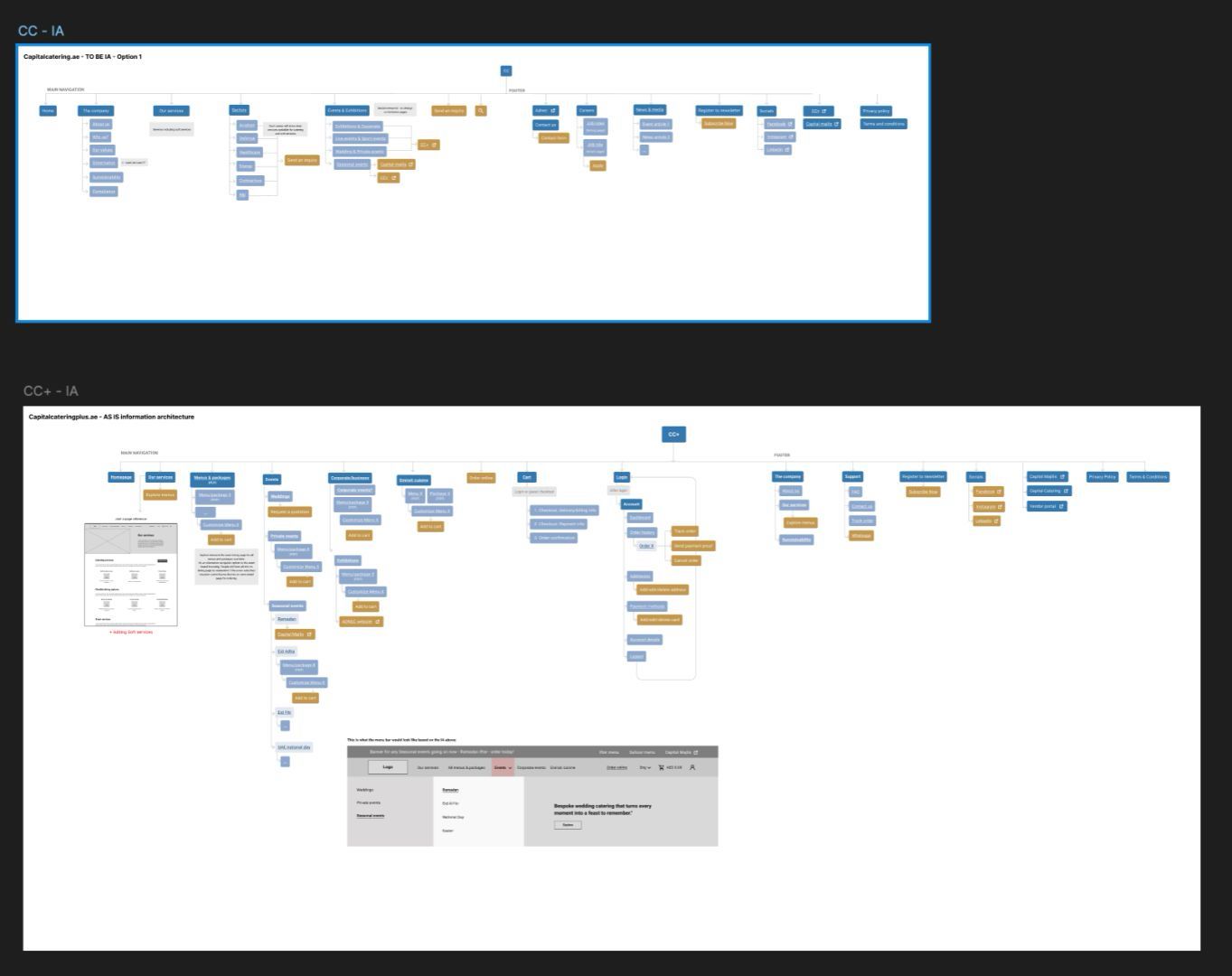
One of DOT’s most impactful contributions was restructuring the menu system. The original 20+ menus were consolidated into two scalable templates: an itemized menu (allowing customers to select individual dishes with a minimum spend threshold) and a package menu (offering set menus priced by guest count, with add-on services like buffet setup and service staff). This consolidation simplified the customer experience while creating a reusable framework the development team could build on within WordPress’s constraints.
The team designed comprehensive business rules to govern the ordering flow. These rules addressed scenarios such as lead-time restrictions on certain dishes, cart behavior when switching between menu types, and conditional availability based on order date. Each rule was documented and translated into wireframes that accounted for edge cases across the full checkout journey.
Visual design and UI execution
Before moving into UI design, DOT developed three visual direction concepts: Pure Aesthetics (premium and elegant), Modular (rounded edges, dynamic shapes), and Corporate (clean and structured). Capital Catering selected the corporate direction for the CC informational site and a blend of modular and pure aesthetics for the CC+ ordering platform. This reflected their desire to maintain institutional credibility on one side while creating an inviting, food-forward experience on the other.
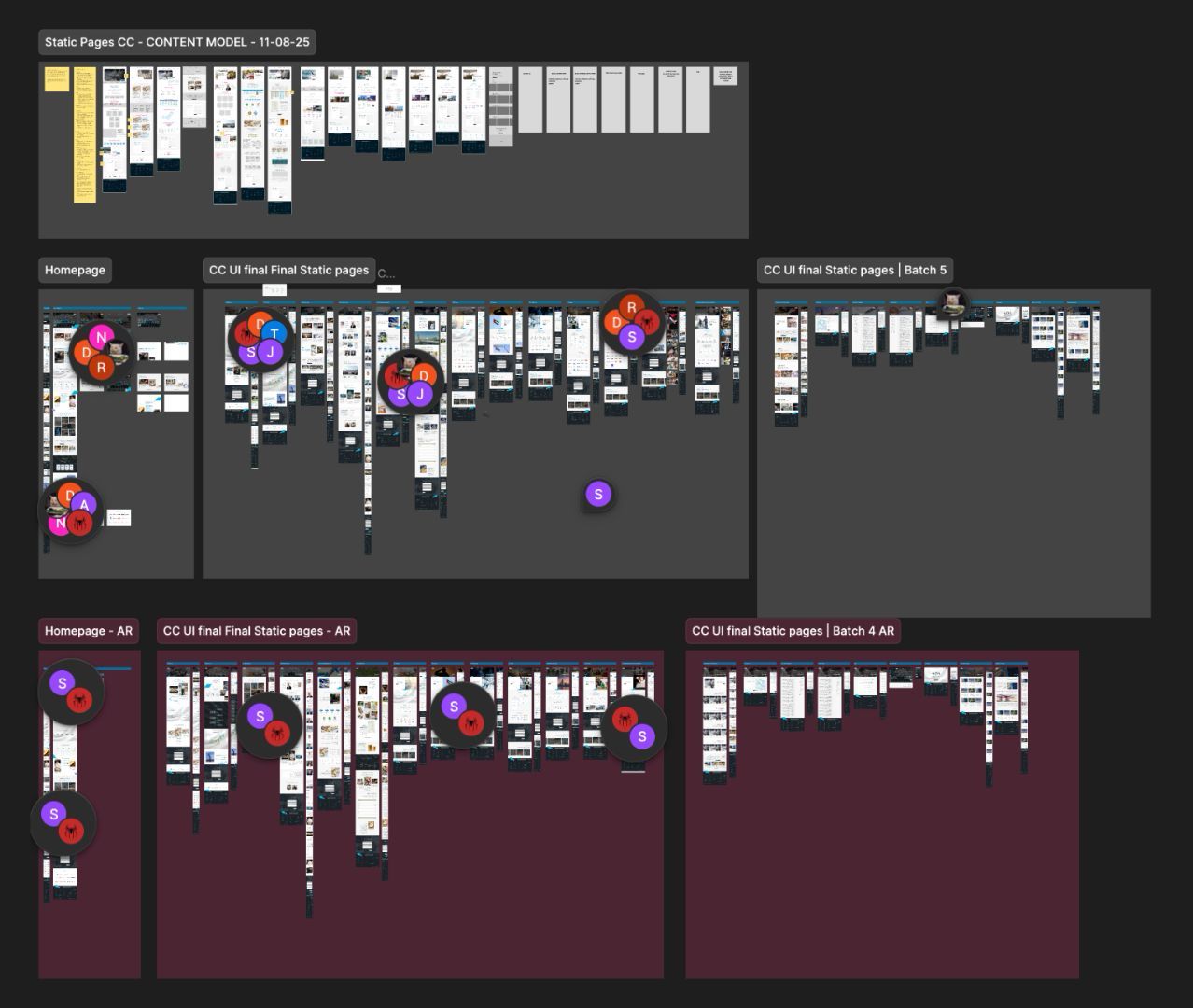
Every screen was designed in Figma to dev-ready specifications, covering web and responsive mobile layouts in both English and Arabic with full right-to-left (RTL) support. The design scope included not just menus and product pages, but the complete transactional flow: cart management, multi-method checkout (credit card and bank transfer), order confirmation, and a full suite of transactional emails covering confirmations, cancellations, and status updates.
Development collaboration and training
The technical build ran on Wordpress with e-commerce and multilingual capabilities. DOT coordinated with external development partners throughout the build, navigating the technical constraints of the platform while preserving the designed experience.
To ensure long-term sustainability, DOT delivered comprehensive CMS training to the Capital Catering team. This covered WordPress administration, menu and item management, marketing campaign setup, and ongoing site maintenance. The training was accompanied by full process documentation to support the internal team post-handover.
DOT delivered two complete digital platforms for Capital Catering, each designed to serve a distinct strategic purpose.
Capital Catering (CC) is a brand-forward informational website that communicates Capital Catering's positioning as a premium provider. The site covers services, leadership, sustainability, and company information, delivered in English and Arabic with fully responsive layouts.
Capital Catering+ (CC+) is a fully functional e-commerce ordering platform that replaced the manual, phone-based ordering process entirely. The platform features two streamlined menu formats (itemized and package), a complete checkout flow supporting multiple payment methods, and a transactional email system covering order confirmations, cancellations, and status updates. Like CC, it was delivered bilingually with full responsive and RTL support.
DOT managed the project end-to-end, from discovery and design through to development and launch, coordinating with external development partners to bring both platforms to production. Post-launch, the team delivered CMS training and process documentation to equip Capital Catering with the knowledge to manage and maintain both platforms independently.
For Capital Catering, this project marked a fundamental shift from an entirely manual operation to a structured digital platform. Where clients previously navigated 20+ menus through phone calls and spreadsheets, the redesigned system offers a clear, intuitive path from browsing to checkout.
More than a design delivery, DOT's role was to bring clarity to a complex, multi-stakeholder environment where internal alignment did not yet exist. By facilitating that alignment across departments, consolidating a fragmented menu system into two scalable templates, and designing within real technical constraints, the team delivered a platform that balances operational feasibility with customer experience.
The project also established a foundation built to grow. The templated menu system and modular design approach mean that as Capital Catering expands into new service lines or menu categories, the platform can scale with the business, without requiring a redesign from scratch.
 UAE: 1507, The Dome Tower, Cluster N, JLT, Dubai, UAE
© 2026 Digital of Things DMCC. All rights reserved | Privacy policy


