AI feature research for a UAE bank
From prototype to POC

From prototype to POC
A major UAE bank, in partnership with a global payments network, was preparing to launch a first-of-its-kind generative AI feature within their mobile banking app. The feature would allow customers to discover personalised lifestyle offers - from dining and entertainment to retail - through natural voice or typed conversation with an AI assistant.
Before committing to a full build, the bank needed to know whether the concept would land with real users. Digital of Things was engaged to validate it with customers.
A generative AI assistant embedded in a banking app was new territory for the client and for its customers. Before investing further, the team needed evidence, not assumptions, on a set of open questions:
Getting this wrong after launch would mean a costly rebuild and a missed opportunity to differentiate in a crowded banking app market. The client came to DOT with a clear brief: pressure-test the concept before it went any further.
The work moved through three phases.
DOT designed a moderated usability study built around a prototype of the feature, structured to test every key touchpoint end to end. Ten participants were recruited to match the target demographic precisely - a mix of existing and non-customers, spanning multiple nationalities, age ranges, and device types.
Sessions ran across three days in DOT's research lab in JLT, Dubai, with each participant completing a structured one-hour session. The lab's eye-tracking and emotional response capabilities captured both what participants said and what they actually did, revealing gaps between stated preference and real behaviour that surveys alone would miss. The team assessed the experience across the homepage entry point, onboarding screens, the AI conversation interface, microphone permissions, and individual offer detail pages.
Every finding was severity-rated, from major friction to positive signals worth amplifying, and paired with a recommendation the product team could act on. The concept itself tested well: participants were receptive to AI-powered offer discovery in a banking context, and the proposition generated genuine interest. But the research also surfaced meaningful gaps between what the prototype communicated and what users understood:
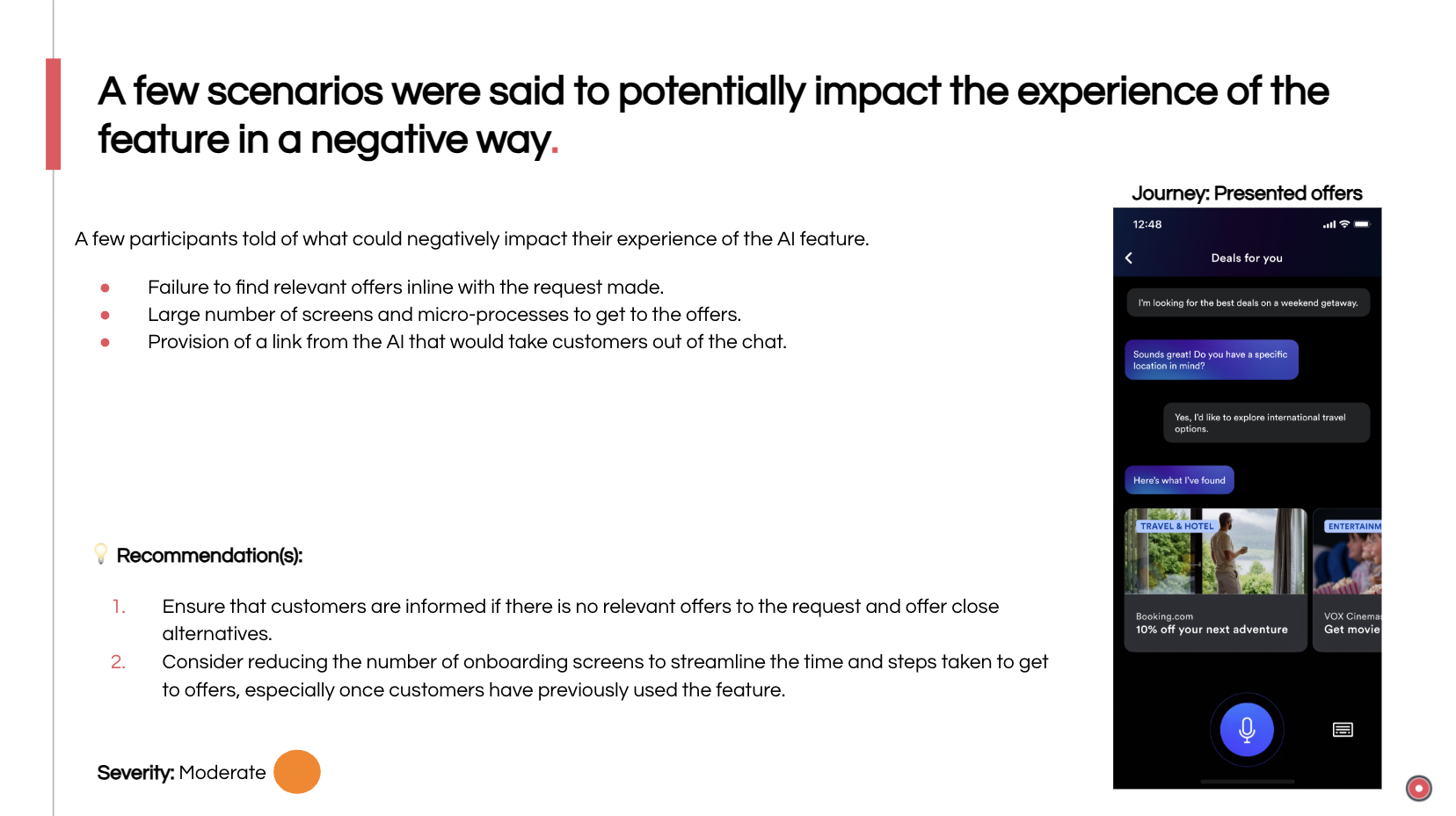
The client received a detailed findings and recommendations report covering 20+ screens and interactions, with fixes prioritised against effort and severity. It gave the product team a clear, evidence-based picture of where to invest before MVP release, including several quick wins that could meaningfully increase feature uptake without significant development effort.
Participants expressed genuine enthusiasm for AI-curated offers once the journey friction was resolved, validating that the underlying proposition had strong commercial potential.
The client acted on DOT's recommendations and successfully launched the POC. DOT's research gave the team the confidence and direction to move from a promising prototype to a live product, shaped by real user behaviour rather than assumptions.
 UAE: 1507, The Dome Tower, Cluster N, JLT, Dubai, UAE
© 2026 Digital of Things DMCC. All rights reserved | Privacy policy


